Chapters 6, 7, 9: Voice First, Find Your
Voice First: How Talking Your Book Into Existence Actually Works
By Michael Giannulis · Author of Talk Your Book Into Existence · 3 min read

Every expert already has a process for communicating their expertise at its best. It is not writing. It is talking. In a client meeting, on a stage, in the first conversation with a qualified prospect, the ideas come out clearly, in the right order, with the right examples. The voice is specific. The thinking is structured. The authority is audible. The Voice-First Publishing System is built on a single premise: start there.
Voice First, Everything Else Second means that the primary raw material of your book is captured speech, not written prose. Not transcribed notes taken by someone else. Not a summary of your methodology produced by a researcher. Your voice, answering specific questions designed to extract the knowledge you have accumulated, organized according to a structure that fits the book you actually need to write.
The extraction step works through an interview-based process. Questions are designed to surface what you know at the level of principle, not just the level of tactic. What is the problem most of your clients arrive with that is not actually the real problem? What is the counterintuitive thing you learned in year fifteen that you could not have told someone in year three? What is the move most people in your field make that you think is wrong, and why? These questions produce the raw material that a polished outline and a generic template never reach.
Before the interviews begin, there is a prior step that most published experts identify as the one that made everything else possible. Finding your signature system. Not inventing it. Finding it. You already have a process you run. A sequence of decisions you make in a specific order. A framework you explain in every serious client engagement. It has a shape. It just does not have a name yet. Chapter 7 of Talk Your Book Into Existence is built around surfacing that mechanism, naming it, and making it the spine of your book.
The signature system matters for a specific reason. A book that presents accumulated wisdom is useful. A book that presents a named, ownable system that solves a specific problem for a specific reader is an authority instrument. The reader does not just learn from it. The reader associates that system with you and only you. That association is what the Authority Gap is ultimately about.
Once the signature system is named and the book type is chosen, the interview process becomes the engine. The conversations capture the content. The organization step gives it the structure that holds. The production step takes that organized content and produces a manuscript in the author's voice. Not a voice that sounds like a business book. A voice that sounds like the author on their best day, making their best case, to a reader who needs exactly what the author has spent twenty years developing.
The 30-day frame is real, not a marketing shorthand. It reflects what is possible when the method is interview-based rather than manuscript-based. An expert who bills $300 to $1,500 an hour cannot afford 500 hours. They can afford a structured series of conversations, an organized output, and a production process that does not require them to become a writer. The system is designed to fit inside the life the expert already has, not to require a sabbatical from it.
The honest version of the Voice-First Publishing System is this. You do not need to write. You need to talk. You need to talk in response to the right questions, in the right order, with someone or something that knows how to organize what comes out and render it in a form that a reader can hold. That is what Talk Your Book Into Existence is built to walk you through, step by step, from first conversation to published author.
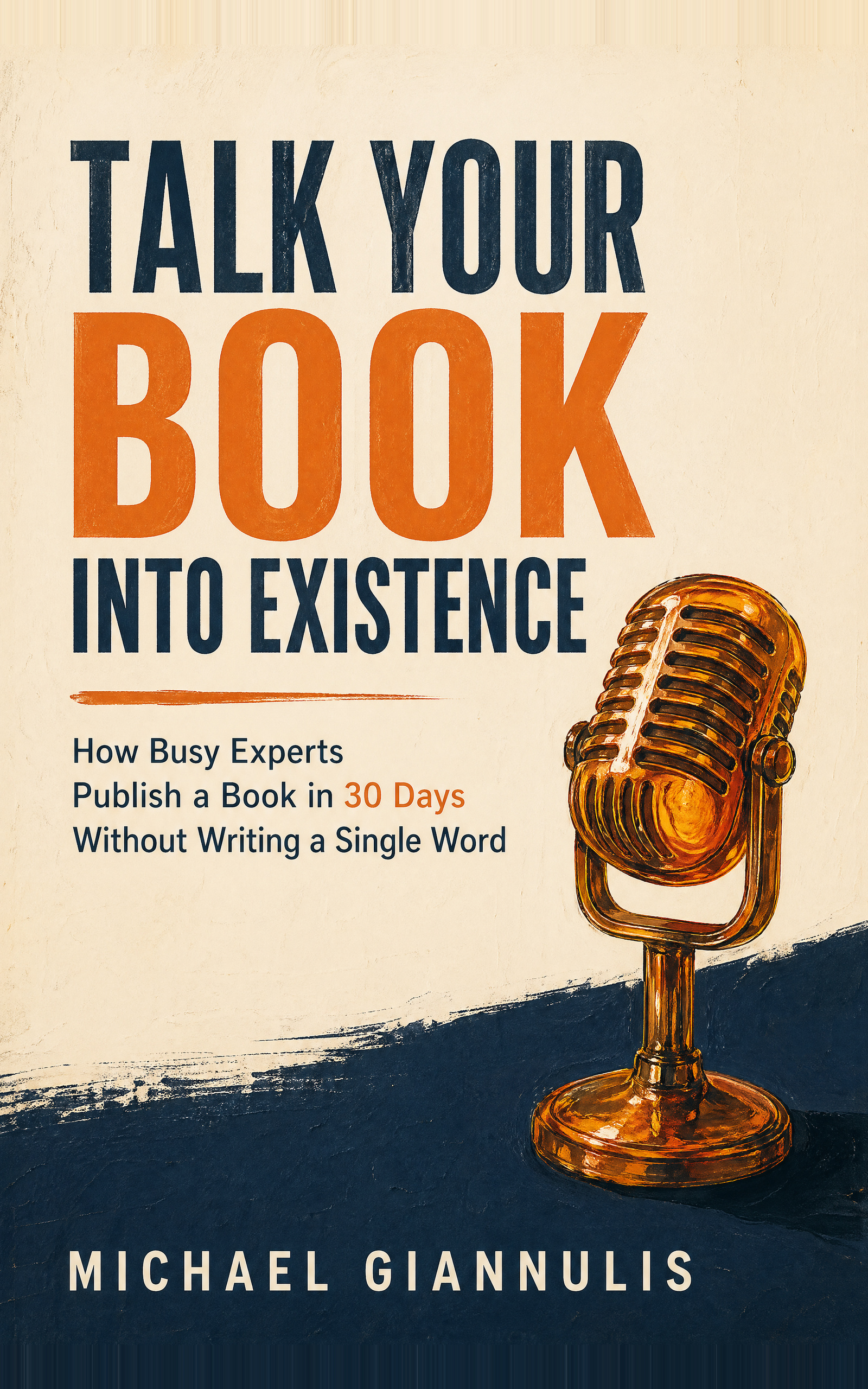
This essay comes from
Talk Your Book Into Existence
How Busy Experts Publish a Book in 30 Days Without Writing a Single Word