Chapter 4: The Four Failed Paths
The Four Failed Paths: Why Every Workaround Breaks Before the Finish Line
By Michael Giannulis · Author of Talk Your Book Into Existence · 3 min read

Most experts who have not published yet have already tried something. A ghostwriter interview that produced a draft that did not sound like them. A three-day writing retreat that generated momentum and then collapsed the week they returned to their practice. A writing course whose template did not fit what they actually needed to say. A commitment to 1,000 words a day that lasted eleven days.
Here is the thing. None of those failed because the expert lacked discipline. They failed because each approach was solving the wrong problem. The real problem is extraction: getting decades of expertise out of a specific person's head and into a structured manuscript that still sounds like that person. None of the four standard paths are built to solve that problem.
The ghostwriter model breaks first at the voice. A skilled ghostwriter can produce clean, professional prose. What a ghostwriter cannot do is replicate the specific texture of how you think, the examples you reach for instinctively, the counterintuitive point of view you have developed over two decades. The draft comes back polished and flat. You read it and feel nothing. Most experts shelve it.
The writing retreat model breaks at reentry. Momentum built in three days of protected time evaporates when you return to a practice, a caseload, or a client roster that does not pause because you attended a workshop. The problem was never inspiration or environment. The problem is that the work of extraction requires a system, not a setting.
The course and template model breaks at fit. A template gives you structure that was designed for a book someone else needed to write. When your expertise does not map cleanly onto that structure, you spend more time fighting the template than filling it. The book you need to write has a shape that comes from your thinking, not from a framework built for a generic expert in a generic field.
The daily habit model breaks at economics. Five hundred hours at a keyboard is a reasonable estimate for a business book written the traditional way. For someone billing $300 to $1,500 an hour, that math never resolves. Every hour spent writing is an hour not spent doing the work that pays. The guilt of not writing is real. But the structural problem is that the standard method was never designed for people whose time is priced the way an expert's time is priced.
What all four paths share is that they treat publishing as primarily a writing problem. It is not. It is an extraction and organization problem. The knowledge exists. The point of view exists. What does not exist yet is a reliable system for pulling that knowledge out of a conversation, organizing it into a structure that holds, and rendering it in the author's own voice without requiring the author to become a writer.
This is the insight that the Voice-First Publishing System is built around. Not that writing is too hard, but that talking is already how experts teach, persuade, and demonstrate expertise in every other context. The interview-based approach takes that existing capability seriously and turns it into the engine of the whole process. The failed paths are not failures of effort. They are failures of method.
This essay comes from
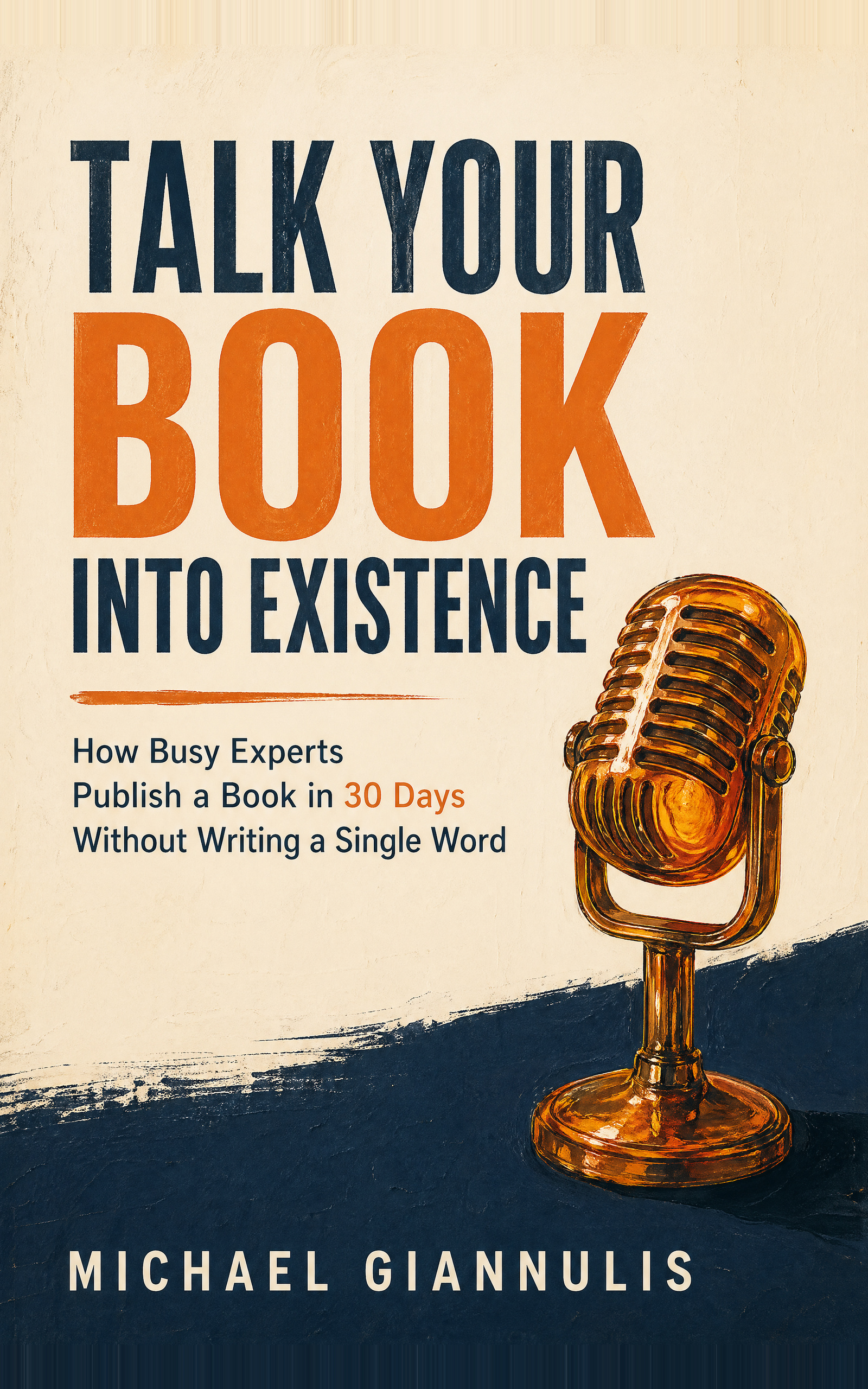
Talk Your Book Into Existence
How Busy Experts Publish a Book in 30 Days Without Writing a Single Word