Chapter 6: Voice First, Everything Else
Voice DNA: Why Your Book Has to Sound Like You, and How to Make Sure It Does
By Michael Giannulis · Author of Talk Your Book Into Existence · 3 min read

Here is the thing most experts will not say out loud. The reason they keep rejecting ghostwriter drafts, abandoning writing tools, and delaying the whole project is not that the content is wrong. It is that it does not sound like them. They read a paragraph and feel a small, specific wrongness they cannot always name. That wrongness is the absence of their voice. And it is not a small problem. A book that does not sound like you is not an authority asset. It is a liability.
Voice is not tone. It is not word choice, exactly, though word choice is part of it. Voice is the sum of how you structure an argument, what you lead with when you are making a point, which words you reach for under pressure, how you handle a transition, and what your natural rhythm sounds like when you are at your most clear. It is the fingerprint of your thinking, not just your speaking. And it is reproducible, but only if you capture it deliberately before you start producing content.
The Voice DNA system is a 6-component voice fingerprint built before the manuscript begins. It is not a style guide. It is a structured capture of how a specific expert actually communicates: the sentence structures they default to, the vocabulary that is distinctly theirs, the cadence of their explanations, the markers that recur when they are at their most persuasive. Once those components are mapped, they become the foundation every page of the manuscript is built on, not a checklist applied at the end.
You do not need X. You need Y. That is a voice pattern. So is leading with the honest warning before the pitch. So is the move from 'here is what I noticed' to 'now watch this.' These are not stylistic accidents. They are the repeating structures that make a piece of writing recognizably belong to one person. Voice DNA captures them systematically so they carry through an entire book rather than appearing only when the author is writing in their best hour.
The interview-based method works precisely because conversation is where authentic voice lives. When an expert is asked a well-structured question about something they know deeply, they do not perform their expertise. They explain it. The rhythm, the vocabulary, the logic of the argument, all of it emerges naturally. A skilled extraction process captures that and uses it as the raw material for every chapter. The manuscript is built from the inside of the expert's thinking outward, not imposed from a template inward.
The Three-Layer Question System is the engine underneath the voice capture process. The first layer opens the expert's thinking on a topic. The second layer goes deeper into the mechanism of what they know. The third layer draws out the stories, examples, and specific language that make the explanation belong unmistakably to this person. The layers work together to surface not just the content of the expertise but the expert's way of holding it.
The Content Scorecard, a 6-category tracking system, and the Continuity Ledger, which maintains consistency across chapters, work downstream of Voice DNA to ensure that a manuscript built over multiple sessions sounds like it was written by one person in one clear state of mind. That consistency is what separates a book that feels authoritative from one that feels assembled. It is also what makes a published book an asset rather than a document you quietly hope people do not read too carefully.
The method is not magic. It is a structured process that starts with the right question asked in the right order by someone trained to listen for the signal underneath the answer. The result is a book that a reader, a client, or a conference organizer picks up and recognizes, immediately and without being told, as yours.
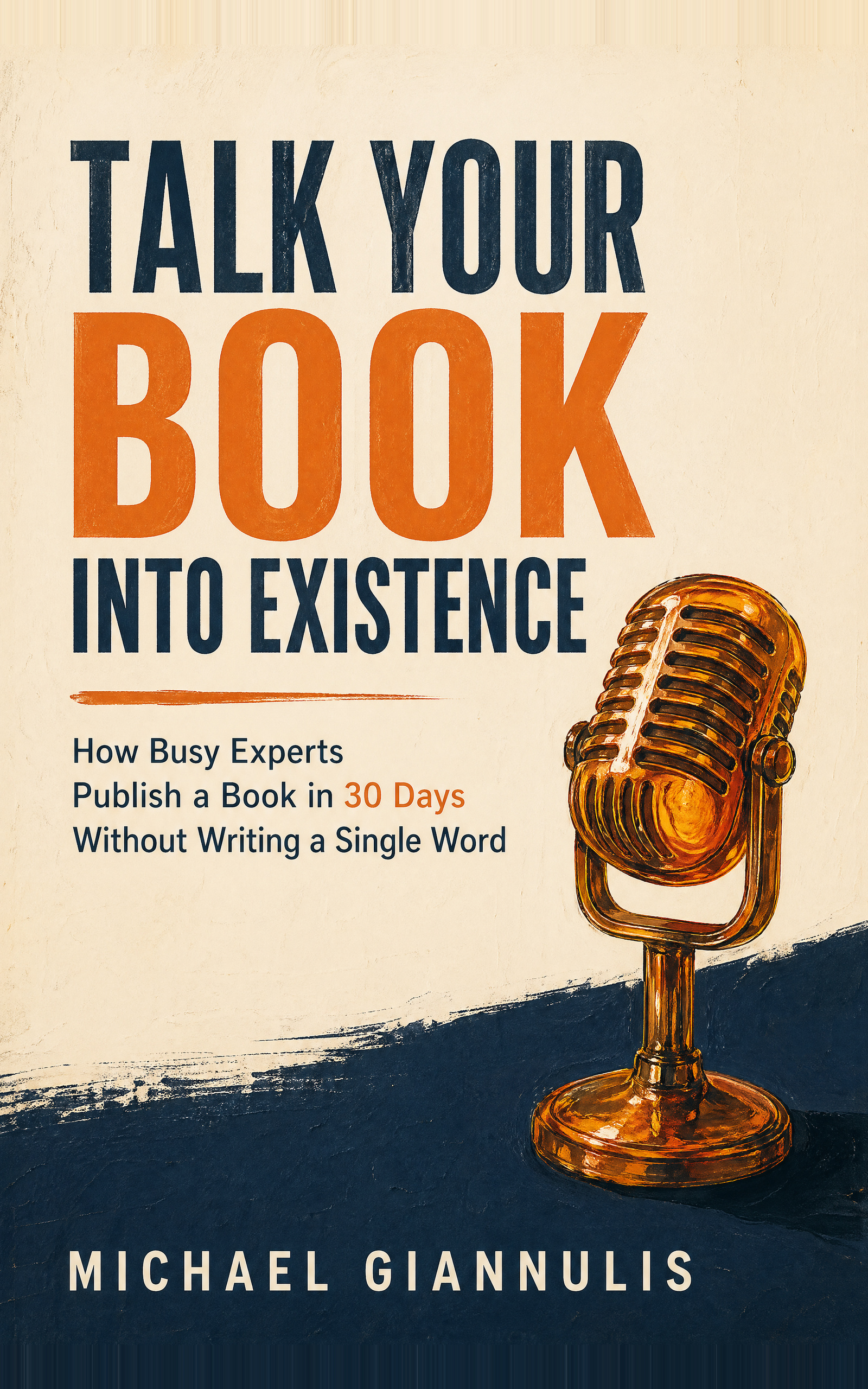
This essay comes from
Talk Your Book Into Existence
How Busy Experts Publish a Book in 30 Days Without Writing a Single Word